On this page
The best way to explain a gap in your CV is to be short, honest and matter-of-fact: say what happened in one line, mention anything useful you did or kept up, and show you are ready to work now. Do not hide the gap, change dates, or apologise at length. Most hiring managers have seen plenty of CVs with gaps; what they want is a clear, believable explanation.
This guide shows where to explain a gap, how to word it on your CV (with examples for common reasons), how to answer in an interview, and what to avoid.
First: how much do gaps matter?
Career gaps are common. People take time out because of redundancy, caring for a child or relative, health, study, travel, relocating, or a long job search. A gap on its own rarely rules you out. What causes doubt is a gap with no explanation, vague dates, or an answer that sounds evasive.
Employers differ, and no one can promise how a particular recruiter will react. What you control is how clearly you explain it.
How recruiters and AI screening tools read gaps
A recruiter scanning your CV looks at dates to follow your story. A gap usually prompts a question, not an automatic no. Clear dates and a one-line explanation answer that question before it is asked.
Automated tools vary. Some AI screening tools read your dates and may list a gap as a note. At SwiftShortlist, where we build screening software for employers, a gap can appear as a note for the recruiter, and a person decides what it means: it does not remove you from the list. Other tools may treat it differently, so the safest approach is the same for everyone: use clear dates and a short, honest explanation. Our guides to how AI scores a CV and the ATS-friendly CV format explain what these tools read.
Where to explain a gap
You can address a gap in three places, and they work together:
- On your CV: one line in your experience section, in the date order where the gap falls.
- In your cover letter: one sentence, only if the gap is long or recent.
- In the interview: a short, prepared answer of about 30 seconds.
How to write it on your CV: examples by reason
Put the gap in your experience list like any other entry, with dates and one line. Here are examples:
| Reason | Example line for your CV |
|---|---|
| Redundancy and job search | Jan 2025 – Aug 2025: Career break after redundancy. Job searching; completed a Level 3 Excel course. |
| Caring for a family member | Mar 2023 – Sep 2024: Full-time carer for a family member. Managed appointments, medication and the household budget. |
| Health | Jun 2024 – Mar 2025: Career break for health reasons. Now fully recovered and available for work. |
| Parental leave or raising children | May 2022 – Jun 2025: Parental leave. Kept skills current through short courses and occasional freelance work. |
| Study | Sep 2023 – Jun 2024: Full-time study, Level 3 Diploma in Business Administration. |
| Travel | Feb 2024 – Aug 2024: Career break. Travelled across Southeast Asia; volunteered at a community project. |
| Relocation | Oct 2024 – Jan 2025: Relocated to Manchester and focused on a job search in the area. |
| Self-employed or freelance | Jan 2023 – Dec 2024: Self-employed, providing bookkeeping services to four small clients. |
You do not need to share medical details. "Career break for health reasons" is enough if you prefer not to give more.
A note on short gaps. If a gap is under a few months, some people list years only for each job (for example "2021 – 2023") instead of months. That is a common formatting choice and is fine as long as the years are accurate. Never change dates to hide a gap: if asked, give the real dates.
How to answer in an interview
Use three short parts:
- What happened. One honest sentence, without drama.
- What you did. Anything useful: courses, volunteering, caring, freelance work, keeping up with your field.
- Why you are ready now. Tie it to the job you are applying for.
Aim for about 30 seconds, then move on. Practise out loud so it comes out calm.
Example: redundancy and job search "My role was made redundant in January and I was job searching for about eight months. I used the time to finish a Level 3 Excel course and tidy up my reporting skills. I'm looking for a role where I can use both, which is why this one caught my eye."
Example: caring responsibilities "I stepped away from work for about eighteen months to care for a family member full time. That's settled now. During that time I managed appointments, medication and the household budget, so I stayed organised and used to dealing with healthcare teams. I'm ready to return, and this role fits the experience I had before."
Example: career break for health reasons "I took a career break for health reasons. I'm fully recovered and have been cleared to work. I've kept up to date with developments in my field and I'm keen to get back into it."
If the interviewer asks a follow-up, stay brief and honest. You are choosing what to share, not hiding anything.
What counts as experience during a gap
Many people undervalue what they did while away from paid work. These are real experience if you describe what you did and the skills involved:
- Caring for a family member (organisation, communication with professionals, budgeting)
- Volunteering
- Courses and qualifications
- Freelance, self-employed or occasional paid work
- Running a household or a community group
If you are in a gap now, a short course, a small volunteering commitment or a freelance project gives you something concrete to point to.
What not to do
- Do not lie about dates. Extending an end date or inventing a job is easy to catch in a reference check and can cost you the job later.
- Do not leave the gap unexplained and hope nobody notices. Questions will come anyway, and a prepared answer sounds calmer.
- Do not apologise at length or over-explain. One or two sentences is enough.
- Do not criticise a former employer. Keep the explanation about you and your plan.
- Do not overshare. Health or family details are your choice to give; you can keep it general.
Your rights in the UK
In the UK, employers should not treat you worse because of protected characteristics under the Equality Act 2010, including disability and pregnancy or maternity. If you think a gap related to health, disability, pregnancy or caring has been held against you unfairly, free guidance is available from Acas and Citizens Advice.
Frequently asked questions
How long is a gap too long? There is no fixed cut-off. What matters more is a clear explanation and showing your skills are current.
Should I leave a gap off my CV? No. Leaving it off or stretching dates creates problems at reference or background checks. Show it, and explain it in one line.
Do I need to explain a gap of two or three months? Usually not. Short gaps between jobs are normal and rarely need a line on your CV.
Do employers ask about career gaps? Often, yes, usually at the interview. A short, honest, prepared answer works best.
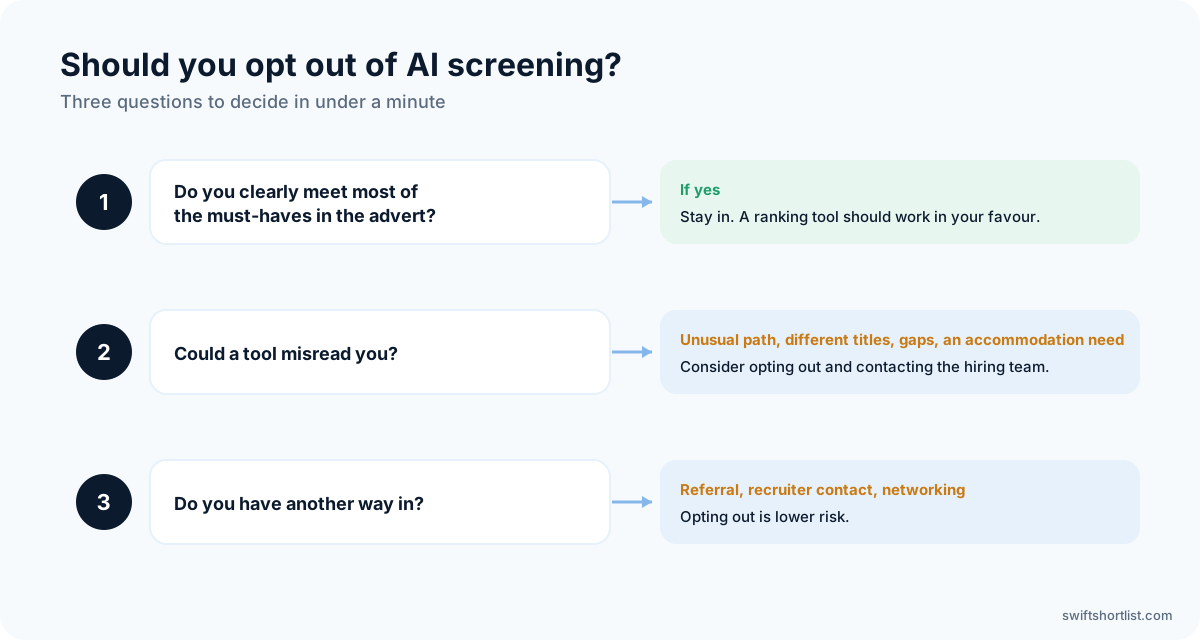
Will an AI screening tool reject me because of a gap? Tools differ. In many, a gap is a note for a recruiter rather than an automatic rejection, and in our tool a person makes the decision. Clear dates and a one-line explanation help in every case. If you are weighing whether to opt out of automated screening at all, read should you opt out of AI resume screening.
What if I have a career change as well as a gap? Lead with what you can do and what you have learned, then explain the move in one sentence. Our guide to competency-based interview questions shows how to turn experience, including unpaid experience, into strong answers.
Hiring for your own team?
SwiftShortlist ranks CVs against your job description in minutes, with the reasons for every score. Free for your first role.